
The Cost of Turnover: The Model a CFO Should Build Before Signing the Replacement Requisition


No organisation approves a bad replacement on purpose. It approves a requisition, the only document in front of it, and a requisition prices one thing: the hire. The cost of turnover is larger, and the difference sits in lines no requisition contains. The model below has two blocks: parameters you look up, and four lines you compute.
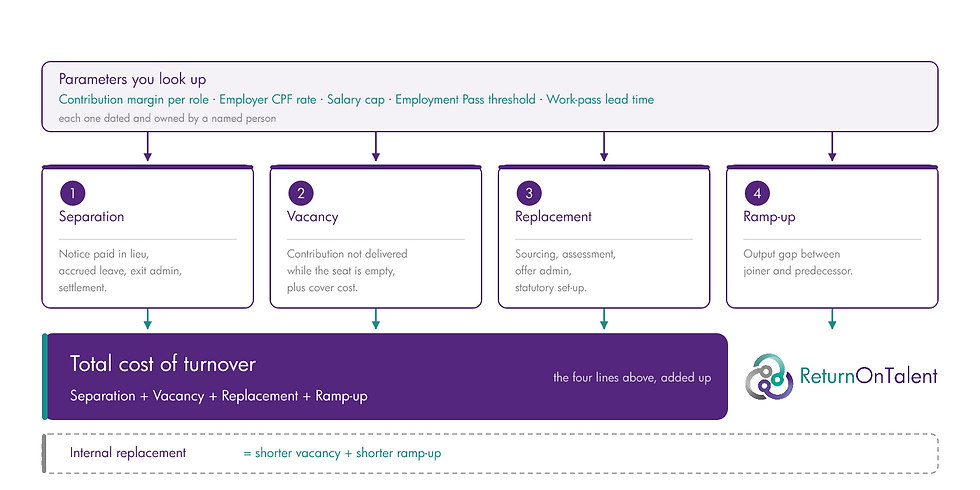
The parameter block is eight values, and each one carries a source and a review rhythm. The model is only as current as the oldest of them.
Contribution margin by role: from Finance, refreshed annually.
Employer CPF rate: from the CPF statutory schedule, 17% for employees aged 55 and below and stepping down in the bands above, reviewed whenever the schedule changes.
Monthly Ordinary Wage ceiling: from the same statutory schedule, on the same trigger.
Employment Pass qualifying salary: from the Employment Pass framework, which sets the floor rather than the market.
Work pass processing lead time: from the same framework, and it is the value that stretches the vacancy line.
Intended departure by function: from the Robert Walters Singapore Salary Survey 2026, which puts the share looking for a new job between 69% and 82% depending on function, refreshed annually.
Months to full productivity by role: from your own HR data, reviewed annually.
Days vacant, trailing actual: from your own recruitment data, reviewed quarterly.
Line 1: Separation
The cheapest line and the easiest to get right, because it leaves a paper trail: notice paid in lieu, encashment of untaken accrued leave, exit administration (final payroll, access removal, offboarding time), and any settlement payment.
Two rules keep it honest. If notice is served rather than bought out, the line is zero: a legitimate answer, not an omission. And the departing employee's ordinary salary does not belong here: it was already in the run rate. Only the delta turnover creates is a turnover cost.
Line 2: Vacancy
This is the line that decides most models, and the line most often missing. It is priced on contribution, not salary: vacancy equals days vacant multiplied by the daily contribution margin of the role.
Use contribution because salary is a saving only if the seat is genuinely unnecessary. If the work is still required, the absence shows up elsewhere: overtime, contractor cover, delayed revenue, service-level slippage, the manager's hours spent covering. That is cash and capacity, and it belongs here.
One market input justifies the caution. In Robert Walters' Salary Survey 2026, between 69% and 82% of Singapore professionals say they are looking for a new job depending on function, from supply chain at 82% down to banking and financial services at 69% (Robert Walters, 2026).
Line 3: Replacement
The line organisations already track, and the one they overstate by loading everything into it: sourcing (advertising, agency fee, referral bonus), assessment (internal interview time at a burdened rate, external assessment), offer administration, and statutory set-up where a work pass applies.
Two disciplines. An agency fee belongs here and nowhere else: if the same search cost also appears under vacancy, it is counted twice. And the new joiner's salary does not belong here. Hiring above the predecessor's salary changes the employment run rate: a different decision on a different document.
Line 4: Ramp-up
Ramp-up equals months to full productivity, multiplied by the productivity gap as a percentage, multiplied by monthly contribution.
The gap is what the joiner delivers against what the predecessor delivered in the same period, month by month. Model it as declining: most of the cost sits in the first quarter, and a flat assumption overstates the tail while hiding the concentration.
The binding rule is timing: write the ramp-up assumption down before the hire starts. Written after the fact it is always zero, because nobody records what they did not get.
The statutory block: two parameters and a gate
This is where a model imported from another market breaks. In Singapore the employer's statutory cost sits above base salary. For CPF-liable employees, employer CPF is 17% of monthly wages for employees aged 55 and below, with the rate stepping down in the older age bands (CPF Board, current statutory schedule), applied up to a monthly Ordinary Wage ceiling. Take that ceiling from the current schedule rather than from memory.
Two rules follow. CPF is a cost of employment, not a cost of turnover: it enters the model only where turnover changes it. A replacement at a different salary, age band or pass arrangement changes the statutory delta, and that delta is the number. And the pass arrangement is a flag on the hire, not a footnote: foreign hires carry a different statutory stack, so record one row per hire with pass type, salary and treatment.
The Employment Pass is a gate, not a cost line. Its qualifying salary is a statutory floor: if a role's budget sits below the current threshold, the foreign-hire path is unavailable at that salary, whatever its pricing. Take the threshold from the published schedule and record a yes/no gate. Processing time is different: it feeds the vacancy line by lengthening days vacant, not the replacement line as an invoice.
The internal variant
The same four lines price an internal move, with three changes. Separation is normally zero. Replacement is the internal process cost: assessment, handover, administration. Ramp-up is shorter because the joiner already knows the business, the systems and the customers.
The line that cannot be left out is the donor vacancy: an internal move relocates a vacancy, it does not delete one.
Internal replacement cost is the sum of three lines: vacancy in the donor role, replacement through the internal process, and a shorter ramp-up.
Cost both paths for the same role, in the same file, in the same quarter. Cost only one and the output is not a comparison: it is a preference with a number attached.
What does not belong in the model
A model is defined as much by its exclusions as by its lines.
The departing employee's salary beyond notice. That is payroll, not turnover.
The new joiner's full salary. That is continuing employment cost.
A search fee entered twice, under sourcing and under vacancy.
Productivity claims without a denominator.
Any benchmark that does not name a function and a year.
A culture cost with no unit: list it separately, marked unquantified, not folded into a line.
Running it
Use the model quarterly, not as a one-off valuation: keep one baseline for turnover cost incurred and report turnover cost avoided against it. State assumptions on the same page as the total, and keep the parameter list beside the model so a reader sees which values moved. The value is the trend line, not any single reading. The second quarter tells you whether last quarter's vacancy duration was honest.
Copy this
Copy the structure below, then fill the parameter block from the current statutory schedule and your own trailing data. Date every value and name an owner per row.
Separation: notice paid in lieu, plus accrued leave encashment, plus exit administration, plus any settlement.
Vacancy: days vacant multiplied by the daily contribution margin of the role, plus overtime and cover cost.
Replacement: sourcing (advertising, agency fee, referral bonus), plus assessment (internal time at a burdened rate and external), plus offer administration, plus statutory set-up (work pass where applicable).
Ramp-up: months to full productivity, multiplied by a declining productivity gap, multiplied by monthly contribution margin.
Period view:
Turnover cost incurred: the sum of replacement cost across all exits in the period.
Turnover cost avoided: baseline turnover cost minus actual turnover cost.
Internal variant, same role:
Internal replacement cost: vacancy in the donor role, plus replacement through the internal process, plus a shorter ramp-up.
A model with dates and owners survives the quarter it was built in; one without becomes the thing this article was written to replace.
Frequently asked questions
What is the real cost of replacing an employee?
Four lines, not one: separation, vacancy, replacement and ramp-up. A requisition prices only the replacement line, which is why the total is always larger than the number that was approved.
Why do most turnover estimates come out too low?
Because they stop where the paperwork stops. Vacancy is contribution not delivered while the seat is empty, and ramp-up is the gap between what the joiner delivers and what the predecessor delivered. Both are real cash costs and neither appears on a requisition.
Is it always cheaper to hire internally?
Usually, on the four lines: separation is normally zero, the replacement cost is the internal process, and ramp-up is shorter. But an internal move relocates a vacancy rather than deleting it, so cost both paths on the same role, in the same file, in the same quarter.
Why does Singapore change the model?
Two reasons. The employer's statutory cost sits above base salary, through employer CPF applied up to a monthly Ordinary Wage ceiling. And the Employment Pass qualifying salary is a gate rather than a cost line: if a role's budget sits below the current threshold, that hiring path is unavailable at that salary. Take both values from the current statutory schedule rather than from memory.
Which roles should be modelled first?
The roles where one resignation genuinely damages the plan: revenue-critical, client-facing, or holding knowledge that is written down nowhere. Model five roles properly before modelling fifty approximately.
How often should the model be re-run?
Quarterly, against the same assumptions. Keep one baseline for turnover cost incurred and report turnover cost avoided against it. The value is the trend line, not any single reading: the second quarter tells you whether the first quarter's vacancy duration was honest.


Comments